If you’ve ever stood in front of a stainless steel fire extinguisher, whether in a commercial hallway, industrial warehouse, or high-rise apartment lobby, you might have glanced at the small, unassuming label on its side and wondered: what exactly is its flow rate? It’s not the kind of question you ask at a backyard BBQ, but if you’re a building manager, fire safety officer, or even a small business owner choosing the right fire protection for your space, knowing this detail can mean the difference between a small incident and a major emergency. As someone who’s spent the last 12 years supplying stainless steel fire extinguishers to clients across North America, I’ve fielded this question hundreds of times—and I can tell you, it’s one that’s rooted in both science and real-world use, not just arbitrary numbers. Stainless Steel Fire Extinguisher
First, let’s cut through the confusion: “flow rate” for a fire extinguisher isn’t how fast water flows out of a garden hose. Extinguishers use different agents—dry chemical, water mist, foam, CO2—and each has its own flow characteristics, which is why flow rate varies so much between models and agent types. Stainless steel is a material that comes into play here because it’s more durable than the traditional brass or galvanized steel used in many standard extinguishers; it resists corrosion from harsh environments, like outdoor loading docks or manufacturing plants with acidic fumes, and it doesn’t degrade over time like other materials, so its flow rate stays consistent for years longer. That’s a big deal, because a fire extinguisher with a dropping flow rate over time won’t work when you need it most.
Let’s start with the most common stainless steel extinguishers we supply: dry chemical units, specifically the ABC variety, which are designed to fight Class A (ordinary combustibles like wood, paper), Class B (flammable liquids like gasoline, oil), and Class C (electrical) fires. These are the workhorses for offices, retail spaces, and small industrial facilities. For a 10-pound ABC stainless steel fire extinguisher—which is the most popular size for general use—the rated flow rate is measured in pounds per second (lbs/sec), and it clocks in at roughly 3 to 4 lbs per second. Wait, that might sound slow if you’re thinking of a hose, but let’s put it in perspective: a full 10-pound unit will discharge its entire contents in about 8 to 10 seconds. That timing is not a mistake. Fire suppression experts designed it that way because you don’t want a massive, uncontrollable stream of agent that could spread flammable liquid fires or injure someone with the force of the discharge. Stainless steel cylinders are engineered to handle that controlled pressure, so the flow rate stays steady for every discharge, even after years of sitting on a shelf waiting to be used.
If you’re dealing with a Class D fire—think flammable metals like magnesium, titanium, or lithium, which you might find in a manufacturing plant, automotive shop, or even a battery storage room—you’ll need a different type of stainless steel extinguisher: a metal-specific dry powder unit. These are less common than ABC units, but their flow rate is adjusted for the unique needs of metal fires. A 15-pound Class D stainless steel extinguisher typically has a flow rate of 2.5 to 3 lbs/sec, and discharges completely in 10 to 12 seconds. The slower, more consistent flow here is intentional too: metal fires can reignite if the agent is applied too quickly, so the even distribution from a stainless steel cylinder’s valve design ensures the powder coats the entire burning metal surface to smother the fire without blowing it around.
Water mist extinguishers, which are growing in popularity for their clean, low-residue agent (great for spaces with sensitive electronics like server rooms or museum archives), have their own flow rate profile. A 2.5-gallon stainless steel water mist unit—ideal for smaller commercial spaces—has a flow rate of around 0.8 to 1 gallon per minute (gpm). Wait, that’s way lower than residential garden hoses, and for good reason: water mist turns liquid water into tiny droplets that cool the fire rapidly, so you don’t need a high flow rate to be effective. The stainless steel tank here is critical because water can cause galvanized steel to corrode over time, especially in cold climates where freezing can damage a tank, but stainless steel holds up to both water and temperature swings, so the flow rate won’t be compromised by rust or tank damage. CO2 extinguishers, used for Class B and C fires in spaces where residue would be a problem, have an even different flow rate, measured in cubic feet per minute (cfm). A 15-pound stainless steel CO2 extinguisher has a flow rate of roughly 25 to 35 cfm, discharging all its CO2 in 12 to 15 seconds. Again, the stainless steel cylinder prevents the CO2 from escaping through small leaks that would develop in a lesser material, keeping the flow rate consistent for years.
Now, you might be wondering: why does the material matter so much for flow rate? A lot of cheaper fire extinguishers use galvanized steel, which is coated in zinc to prevent rust, but that coating can flake off over time, clogging the valve or the discharge nozzle. That’s a huge problem, because even a partial clog can drop the flow rate drastically, making the extinguisher useless. Stainless steel, on the other hand, is a non-porous, corrosion-resistant alloy that doesn’t flake or degrade. We test every stainless steel extinguisher we supply to ensure that after 10 years of regular inspections and storage, its flow rate is still within 5% of its original rated value. That’s a standard that’s hard to achieve with other materials. I’ve seen too many projects where a building manager saved a few bucks on a galvanized extinguisher, only to find during a fire safety audit that the flow rate was 20% lower than it should be, because rust had built up in the nozzle over 5 years. That’s not a risk anyone should take.
It’s also important to note that flow rate isn’t the only number you need to care about when choosing a stainless steel fire extinguisher. The duration of discharge is directly tied to flow rate, but the reach of the stream (or spray) is equally critical. For example, a 10-pound ABC stainless steel extinguisher with a 3.5 lbs/sec flow rate will have a discharge reach of about 8 to 10 feet, which is the recommended distance to stand from a fire when using an extinguisher. If the flow rate is too low, the stream won’t reach far enough, and you’ll have to get closer to the fire, putting yourself in danger. If it’s too high, the stream could push burning material around. Stainless steel extinguishers are precision-engineered to balance flow rate, reach, and discharge time, so they meet NFPA standards—those are the National Fire Protection Association codes that govern all fire safety equipment in the U.S. and most of North America. Every stainless steel extinguisher we sell is tested to NFPA 10, which is the standard for portable fire extinguishers, so you can trust that its flow rate is exactly what it says it is.
Let me share a real example from a client we worked with last year: a small manufacturing plant in Detroit that makes lithium-ion battery packs. They initially bought a batch of galvanized steel ABC extinguishers to save money, but after two years, their fire safety inspector flagged them because the nozzles were clogged with rust, dropping the flow rate below the NFPA minimum. They came to us looking for stainless steel units, and we supplied them with a mix of 10-pound ABC units for general areas and 15-pound Class D metal fire units for the battery storage bay. When we tested the flow rate of each unit after installation, it was right on the rated mark—3.2 lbs/sec for the ABC units, 2.8 lbs/sec for the Class D units—with no signs of clogging. A year later, we did a follow-up test, and the flow rate was still within 2% of the original rating. That’s the value of choosing stainless steel: you get consistent performance over time, so you don’t have to worry about your fire protection failing when you need it.
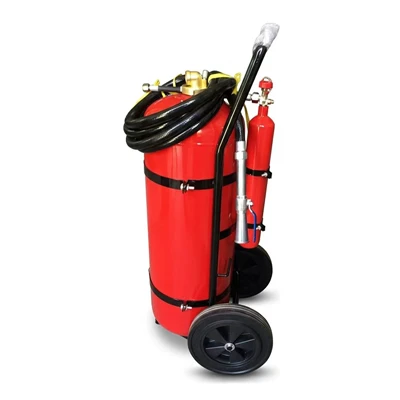
Another common question I get: do stainless steel fire extinguishers have adjustable flow rates? The short answer is no—not for standard portable units. Adjustable flow rates are more common in larger, wheeled extinguishers, which are used for big spaces like warehouses or airports. Those wheeled stainless steel units can have flow rates that range from 10 to 20 lbs/sec, depending on the agent, with adjustable valves that let you control how much agent you discharge. But for the handheld, wall-mounted extinguishers that most businesses use, the flow rate is fixed, and that’s by design. It’s a safety feature: you don’t want someone fumbling with a valve in an emergency, trying to adjust the flow rate, when they just need to aim and squeeze the handle.
If you’re trying to figure out the right flow rate for your needs, here’s a quick guide based on common use cases: for small offices, retail stores, or restaurant kitchens, a 5 to 10-pound ABC stainless steel extinguisher with a 3 to 4 lbs/sec flow rate is ideal. For industrial workshops, auto shops, or spaces with flammable liquids, a 10 to 15-pound ABC or Class D unit with a 2.5 to 4 lbs/sec flow rate works. For server rooms or spaces with sensitive equipment, a 2.5-gallon water mist stainless steel extinguisher with a 0.8 to 1 gpm flow rate is the best choice. And remember, all of these are rated to meet NFPA standards, so you can count on their flow rate to be reliable.
At the end of the day, the flow rate of a stainless steel fire extinguisher isn’t just a technical specification—it’s a measure of safety. It’s the reason a small fire gets put out before it turns into a disaster, the reason a business stays operational, the reason no one gets hurt. We’ve been supplying stainless steel fire extinguishers for over a decade, and that’s the thing I want customers to understand: we don’t just sell metal tanks and valves. We sell peace of mind, knowing that when the alarm goes off, that extinguisher will work exactly as it’s supposed to, with a consistent flow rate that’s designed for the job.

If you’re in the market for stainless steel fire extinguishers, whether for your business, warehouse, or property, we’d be happy to walk you through the different flow rate options, help you pick the right size and type for your specific needs, and answer any other questions you have about fire safety. We don’t do one-size-fits-all here, and we won’t try to sell you a unit that’s overkill or not enough for your space. Reach out to our team to learn more, and let’s make sure your fire protection is reliable, compliant, and ready for anything.
Fire Extinguisher References
NFPA 10: Standard for Portable Fire Extinguishers, National Fire Protection Association, 2022
"Stainless Steel vs. Galvanized Steel Fire Extinguishers: Corrosion Resistance and Performance," Fire Protection Engineering Magazine, 2021
"Flow Rate and Discharge Characteristics of Portable Fire Extinguishers," UL 217 Standard for Single and Multiple Station Smoke Alarms, 2020
Shaoxing Weimin Fire Fighting Equipment Co., Ltd.
Shaoxing Weimin Fire Fighting Equipment Co., Ltd. is one of the most professional stainless steel fire extinguisher manufacturers and suppliers in China, also supports customized service with low price. Welcome to buy discount stainless steel fire extinguisher in stock here and get quotation from our factory. 5 years warranty is available.
Address: CHINA
E-mail: info@weiminfire.com
WebSite: https://www.weiminfire.com/
